
Bartow Criminal Court Records
Bartow County criminal court records are court files, not arrest logs. They begin to take shape when charges are filed or presented to the court and then continue through arraignment, motions, hearings, plea or trial, disposition, and sentencing. Superior Court is the key court for felony criminal cases in Georgia, and Bartow County is in the Cherokee Judicial Circuit. The Clerk of Superior Court is the custodian and filing office for Superior Court criminal case records.
The District Attorney prosecutes state criminal cases in Superior Court for the Cherokee Judicial Circuit. The researched DA pages identify Erle J. Newton III as the District Attorney, with the office at 135 West Cherokee Avenue in Cartersville and phone 770-387-5080. The DA role matters because the prosecutor files or pursues the formal criminal case, while the Clerk maintains the court file and calendar access.
Case flow: Charges filed > Arraignment > Pretrial motions > Plea or trial > Disposition > Sentencing.
| Stage | What the criminal court record may show |
|---|---|
| Charges filed | Accusation, indictment, case number, prosecutor action, or no-bill result. |
| Arraignment | First formal plea setting and next court date. |
| Pretrial | Motions, discovery disputes, bond issues, calendar calls, or hearings. |
| Plea or trial | Guilty plea, trial setting, verdict, dismissal, or amended charges. |
| Disposition | Final outcome for each charge, including dismissed, no-billed, convicted, or appealed. |
| Sentencing | Sentence, probation, restitution, fines, or court costs where included. |
Search Bartow Criminal Court Records
Online Superior Court access uses Georgia Courts e-access and PeachCourt for Bartow Superior. PeachCourt requires account login, so the public page does not function like a no-login county criminal case search. Calendar information is more open through the Clerk of Superior Court calendar page. The calendar page includes criminal calendars by judge and a no-bill list, while questions go to 770-387-5025.
The Clerk's Civil and Criminal Division is at 135 West Cherokee Avenue, Suite 233, Cartersville, Georgia 30120. The criminal email listed in the research is Criminal@BartowCountyGa.Gov. For records not visible through PeachCourt or calendar postings, contact the Clerk rather than using the county administrative NextRequest portal, because Bartow excludes court-related and judicial records from that portal.
The PeachCourt account access page is the researched online route for Bartow Superior Court case documents.

Use calendars for dates and PeachCourt or the Clerk for the case file itself.
- Confirm the case is a Superior Court criminal matter instead of a jail-only, municipal, or Probate traffic matter.
- Check the Clerk's criminal calendar by judge if the need is a court date.
- Use PeachCourt account access for available Superior Court criminal documents.
- Contact the Clerk of Superior Court for certified copies, older files, and records that are not online.
- Use record restriction resources only after understanding the final disposition.
What Bartow Criminal Records Show
A criminal court record can show the State of Georgia as the prosecuting party, the defendant, the judge, the charge documents, the hearing history, the plea or verdict, and the sentence. It may also show bonds, probation terms, restitution, court costs, and whether a charge was dismissed or no-billed. The research did not capture a live sample case record, so field names should be read as typical court-record content rather than a promise that every field appears in every Bartow file.
| Field | What it shows |
|---|---|
| Case number | The court's case identifier when available through PeachCourt, Clerk records, or calendars. |
| Judge and court | The Cherokee Judicial Circuit judge and Superior Court calendar or courtroom. |
| Charge document | Indictment, accusation, or other filed charge record. |
| Docket entries | Arraignment, motions, calendar calls, plea, trial settings, and orders. |
| Disposition | Dismissed, no-billed, plea entered, convicted, sentenced, appealed, or other outcome. |
| Sentence | Jail, prison, probation, fines, costs, restitution, or related terms when ordered. |
Bartow Criminal Charges And DA
The District Attorney represents the State of Georgia in trial and appeal of criminal cases in Superior Court. The Cherokee Judicial Circuit consists of Bartow and Gordon counties. The DA staff includes assistant district attorneys, investigators, victim/witness assistance, and administrative personnel. That office is not the records custodian for every court document, but its role explains why charges may change as a case moves from arrest to a filed court case.
The DA change-of-address page is a practical criminal-court warning. A defendant with an active criminal case must change address in person at the District Attorney's Office if moving from the address listed on bond. Valid photo ID is required. Changing an address with a bond company is not enough, and failure to update the DA and appear can lead to a bench warrant.
The Bartow DA change-of-address page gives the local bench-warrant warning for active criminal cases.
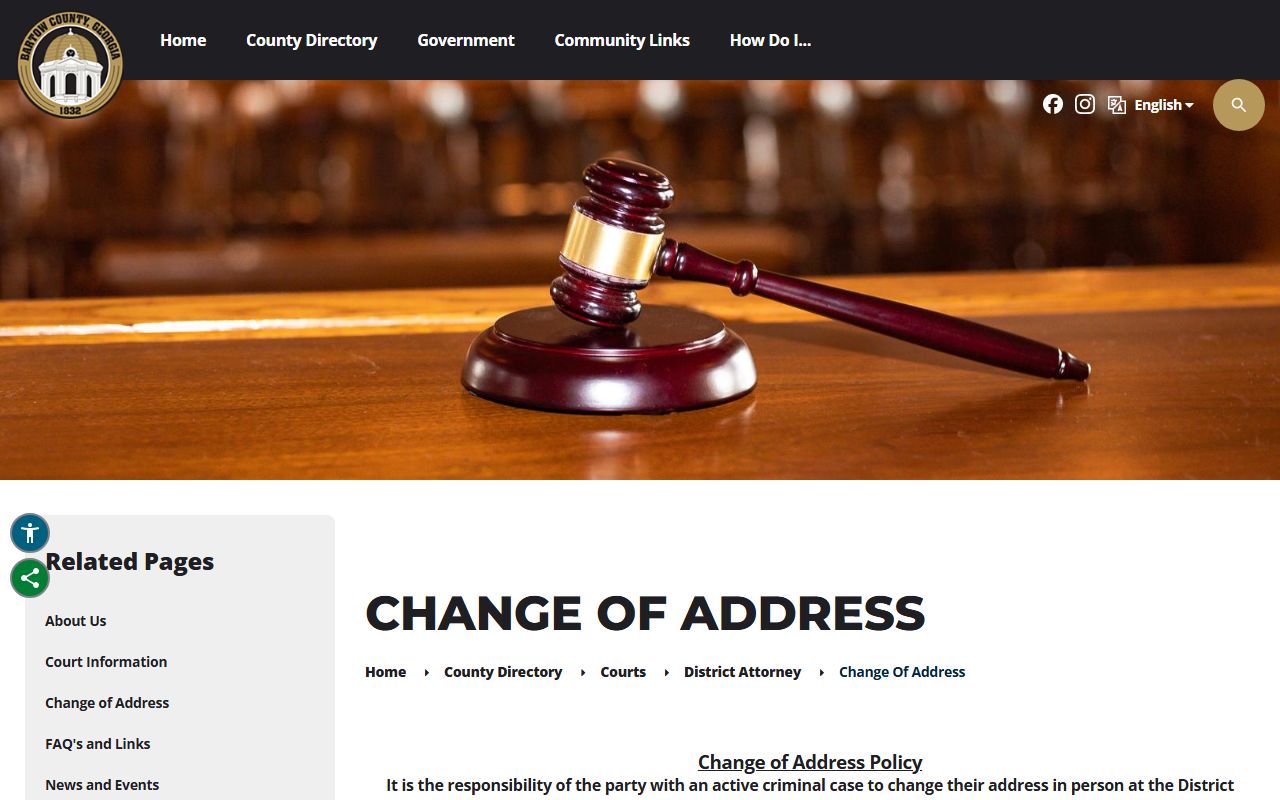
Address updates are a records issue and a court-appearance issue when a criminal case remains active.
Bartow Charges Versus Convictions
A charge is not the same as a conviction. Bartow County criminal court records may show charges that were filed, amended, dismissed, reduced, no-billed, or resolved by plea or trial. A conviction reflects a final outcome after a guilty plea, verdict, or similar adjudication. Reading only the charge line can give a wrong picture of the case.
| Point | Charge | Conviction |
|---|---|---|
| Meaning | An accusation filed or pursued in court. | A final finding or plea resulting in guilt. |
| Timing | Appears near the start of the criminal case. | Appears after plea, verdict, or final disposition. |
| Can change? | May be amended, reduced, dropped, dismissed, or no-billed. | Can be appealed or later restricted only through legal process. |
| Where to verify | Charging document and docket entries. | Disposition, judgment, sentence, and final orders. |
Restricted Bartow Criminal Records
Georgia record restriction can limit public access to eligible criminal history, but it does not destroy every government record. Georgia.gov says public access can be restricted so records do not appear on public or background searches, while judicial officials and criminal justice agencies may still access them. For arrests before July 1, 2013, the request generally starts with the arresting agency. For arrests on or after that date, the person contacts the prosecuting attorney directly.
Prosecutors generally approve or deny within 90 days. GCIC usually processes complete restriction applications within 2-3 weeks after approval, and a denial can be appealed to Superior Court within 30 days. Juvenile cases and sealed cases have separate limits, and adoption or mental-health records should not be treated as ordinary criminal records.
The Georgia record restriction guide explains the pre- and post-July 1, 2013 process.
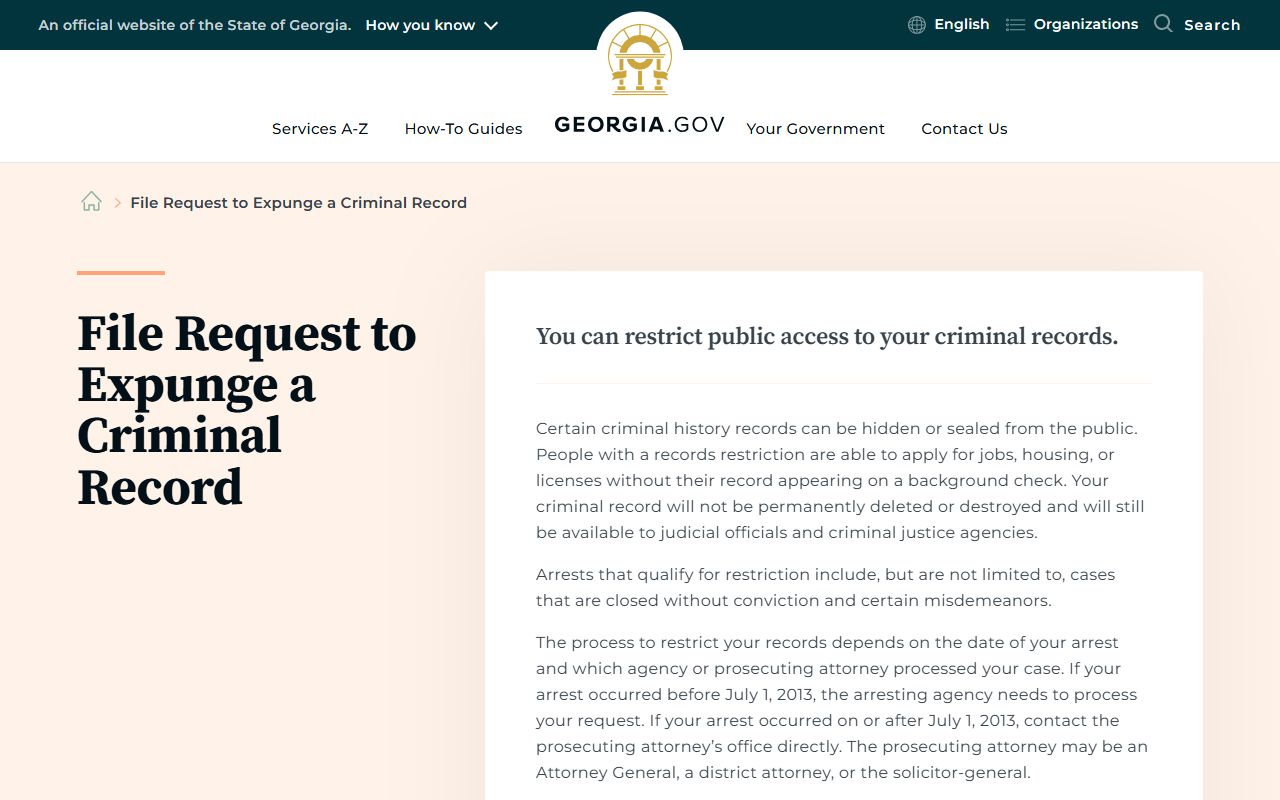
Record restriction depends on the arrest date, final outcome, agency review, and prosecutor or GCIC processing.
The GBI criminal history record restriction page cites Georgia's restriction authority.
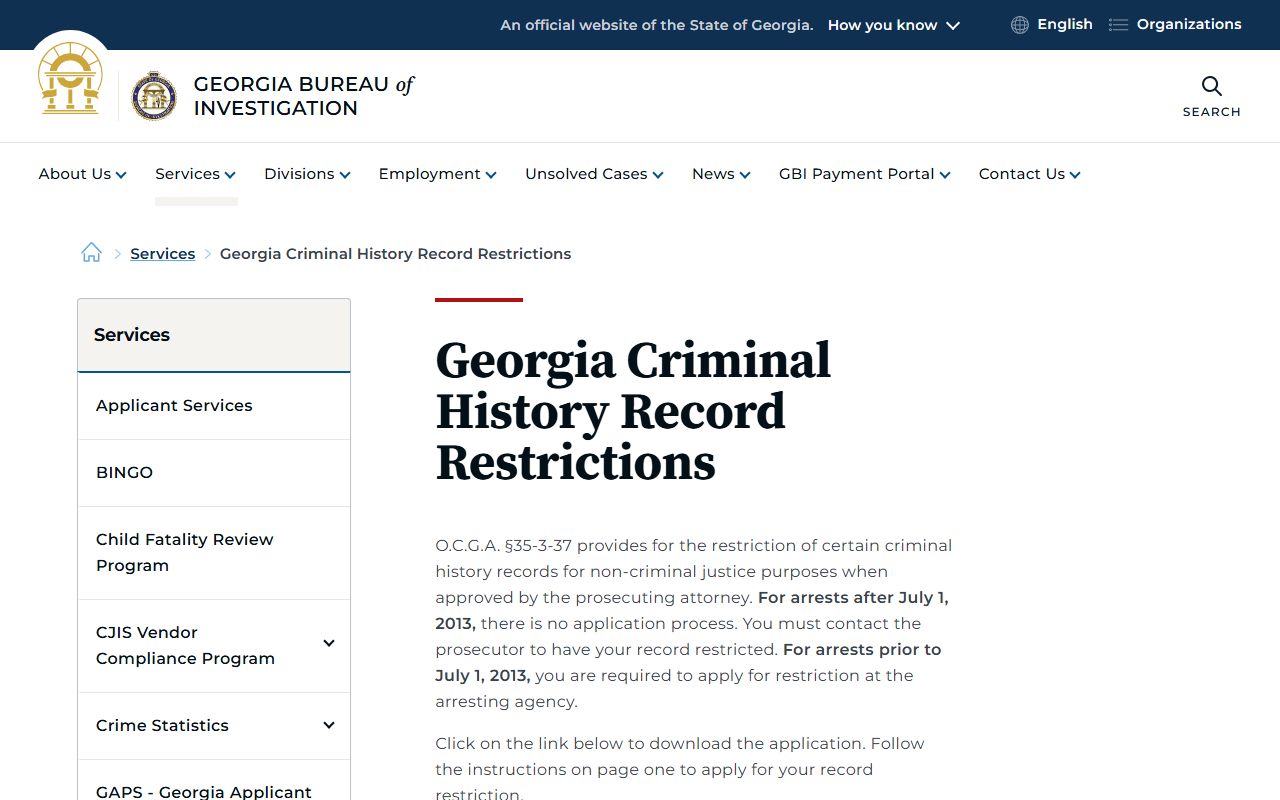
Use GBI and Georgia.gov resources for criminal-history restriction, while court-file copies still route through the court custodian.
Bartow Sealed Versus Restricted
Sealed and restricted records are often confused. A sealed court record is blocked from ordinary public inspection by statute or court order. A restricted criminal-history record may be limited for non-criminal-justice searches, but it can remain available to courts and criminal justice agencies. The terms should not be used as if they mean the same thing.
| Point | Sealed record | Restricted criminal history |
|---|---|---|
| Source | Court order or statute, such as juvenile or adoption limits. | Georgia criminal-history restriction process. |
| Public access | Usually blocked unless the court allows access. | Limited from public/background use when approved. |
| Government access | Depends on law and court order. | Still available to judicial and criminal justice users. |
| Where to ask | The court that sealed or holds the file. | Arresting agency, prosecutor, GCIC, or Superior Court appeal route. |
Bartow Criminal Court Alternatives
Cherokee Judicial Circuit Drug Court is the documented specialty court program for Bartow County. The program is for adults who have pled guilty to one or more non-violent felony drug-related offenses and are having trouble staying clean and sober. It is described as a five-phase intervention program with frequent court appearances, scheduled and random drug testing, group and individual counseling, judicial supervision, education or vocational training, life-skills work, sanctions, and incentives.
The Drug Court team includes Superior Court, District Attorney, probation, public defender, law enforcement, and treatment-provider roles. The researched program page describes an eighteen-month treatment and rehabilitation structure intended to reduce recidivism, jail crowding, and future criminal justice contact. Eligibility and participation are case-specific and must be handled through the court process.
The Cherokee Judicial Circuit Drug Court page describes the current program structure.
Drug Court information belongs in criminal court context because it can affect case path, supervision, sanctions, and outcomes.
Bartow Criminal Defense Records
The Bartow County Public Defender's Office is at 128 West Cherokee Avenue, Cartersville, Georgia 30120, with phone 678-721-3254. The office is open Monday-Friday, 8:00 a.m.-5:00 p.m., and applications are accepted Monday-Friday, 8:00 a.m.-4:00 p.m. The researched page says the office can represent defendants in Bartow and Gordon County Superior Court criminal matters and delinquent matters in Bartow County Juvenile Court.
Its scope limits are important. The Public Defender does not handle Cherokee County, divorce, child support, or cases pending in Municipal or Probate Court. That means a Probate traffic citation, municipal case, or divorce file should not be routed to the Public Defender as if it were a Superior Court criminal record.